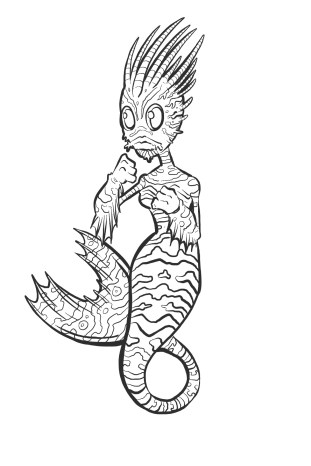
I was working on a mermaid concept for the mythology book last night, and realized that I didn’t want your standard fish lady to represent the Undersea Realms. So, I looked up a bunch of different fish and got really into the lionfish. They are pretty amazing to look at, and have some really neat spines, patterns, and colors. I decided that the lionfish would be the basis of my mermaid design, and here she is:
I still need to work out a background image for her, it’ll probably be a shipwreck of some sort or another. My grandfather loved old sailing ships, and I inherited a little of that. I love the haunted mystique of a wrecked ship on the sea floor.
A friend of mine recently remarked that some plumbing problems we were having were due to Vodniks; my confused, vacant-eyed response led to a really fun story about some Czech friends of hers that blamed Vodnik on any plumbing problems that came up.
It’s been a few months now, and as the resident Cryptozoologist of Salt Lake City, I decided to do a little digging on my drippy little house guests.
The Vodnik is the Slavic cousin to the Russian Vodyanoy, a far more sinister fellow (they are all males) that haunts lakes and rivers. The Vodyanoy are frog like creatures, with aged bodies, froggy faces, fish tales, and long, stringy beards and hair. They paddle about on half sunken logs with their webbed hands, looking for unwary locals to drown. They seem to like wandering about without any clothes, too. Sound familiar?
The Vodnik, by contrast, seems more human like in features, although they are a greenish tint and tend to be covered in moss. They wear tattered, cast off clothing, and also loiter about lakes and rivers. Unlike the Vodyanoy, which are mostly malevolent, Vodniks can be beneficial or dangerous, depending on their mood.
One area that Vodyanoy and Vodnik overlap is that they keep little ceramic containers with them, in which they store the souls of people who have drowned in their domain. The crockery is considered currency to these folk, and a large collection of souls is a sure sign of wealth and influence. If the crockery is opened, however, the soul escapes in the form of a bubble, leaving the vessel it was in worthless.
Fishermen and people who make their living on the water will leave offerings of tobacco to the vodnik, in hopes that they will leave them alone or help them in their industry. A vodnik who feels slighted may attack local water features, such as dams, well, (possibly plumbing) and locks. This behavior has also been reported with Vodyanoy.
In Leicestershire, England, there is a little cave carved into a sandstone cliff. There is an oak tree growing there, and tatters of thin, translucent cloth can be seen fluttering in the breeze upon its branches. This is the bower of Black Agnes, and should be avoided at all costs.
Where the story of Black Agnes (or Annis) originated is lost to history; some say she is the spirit of an ancient Anchorite who died in the cave, others say she is the remnant of the old goddess Danu, pissed as hell and haunting the cave. Some speculate that she is a remnant of the Hindu goddess Kali, with whom she shares some characteristics. Others say she was manufactured by exhausted parents who needed a good bogeyman to keep their kids out of the woods.
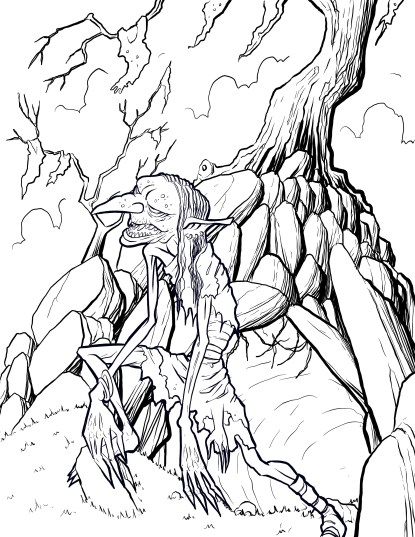
Black Annis is a stooped and aged creature, with sharp iron talons. Her skin is blue, which helps her blend into the night and hunt her favorite prey, which consists entirely of human children. Agnes would lurk outside of a home and wait for a child to wander away into the woods, were she would grab them and haul them off to her bower to eat.
The ancient oak tree outside of Annis’s cave was used to cure the skins of her victims, which she would later drape across her body as skirts and shawls. It is said that Agness carved out the cave herself with her iron-clad claws, and that she still lives there to this day.
Research for most monsters can be a lot of fun, and pretty educational, too. Take this week’s Monster Monday inductee, the Redcap. I had no idea that the people of the border region between Scotland and England had their own unique legends. Makes sense, though, given that this area has been contested and fought over for centuries. Conflict tends to be the mortar with which great legends are built.
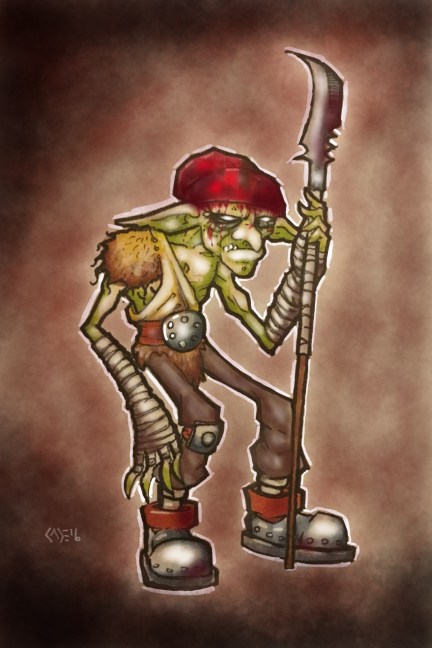
Redcaps are malicious, foul little fiends that live in the abandoned castles and ruins throughout the border regions. They may be related to goblins, or faeries, or perhaps some sort of inbred cave dwarf, but no one can really tell for sure; most folk that glimpse them are too busy running away to tell. Sadly, this rarely works, as Redcaps are some of the fastest creatures of the Other and can easily catch up with the fleetest of human feet.
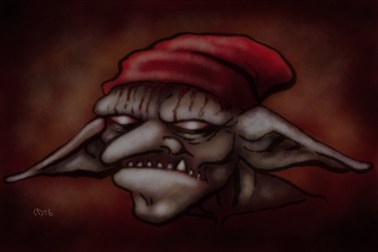
Redcaps have long, tapered fingers, weathered faces, and red tinged eyes. They also sport bright red caps, sewn expertly from human skin. Redcaps are vicious and accomplished slaughterers of humans that wander too close to their haunts, and it’s not just for sport, either; the Redcap needs to keep its hat soaked in fresh blood to stay alive. If the cap dries out, the Redcap will die. Needless to say, this rarely happens.
Redcaps are also known to carry long pikes, which they are very accomplished with. They wear heavy, iron-shod boots, which may be worn to lull their prey into a false sense of security, or perhaps to keep them from running too fast to stay in this realm.
While Redcaps are very common in the Border areas between England and Scotland, there have been several stories of their antics in Ireland, too. The only reliably documented way to defeat a Redcap is to try and hide from them, which is next to impossible, since they tend to know the lay of their lands very well. If you find yourself in the hunting grounds of one of these horrid little beasts, it’s best to make your peace with life; there is probably not much of it left to live.
Salt Lake Comic Con just wrapped day one, and I am shot. Happy and deliriously shot, though. I moderated 3 panels today, one about our cultural fascination with magic, and two on table-top gaming. I really appreciated seeing how many women are getting involved in gaming, it’s refreshing to see a paradigm shift in a traditionally musty, man-centric hobby!
I must apologize for not being as on top of posts as I had hoped to be, but I am going to accept my limitations and realize that I might not be able to hit the post count that I would like. Instead, I thought I would share the origins of Grimmleighs from a few years back!
In 2010, I asked my wife if she would crochet a Nessie for me. We stitched a panel of muslin to it’s head, and I painted a face on it. It was primitive, but it was also an amazingly fun project to make. That was the first Grimmleigh, and we went into a pretty steady production mode for several years. Ultimately, we must have made over a thousand of them!
Ultimately, we couldn’t justify the amount of work involved with the amount of money we made. We had a hard time charging what we should have for them, since we really just wanted to share our cool little monsters with everyone that saw them!
A lot of what you see here has carried over to the monsters I included in Grimmleigh’s Beastly Oddities. I really missed seeing these goofy little creatures, so I am pretty happy to have the “legacy” of Grimmleigh’s live on!
There is a prevailing custom in some older cultures, one in which you take extra care to cover the graves of the recently deceased with stones (or boulders). The reason for which might be as simple as not having any dirt around to backfill the grave, or, if you live in Ireland, it’s a lesson learned from ages passed.
Her name is long forgotten, but her legend lives on. Not for the beauty she radiated in life, but for the terror she harvested in death. She is the Dearg-Due, the Red Blood Drinker. She was once a legendary beauty, born to a family of means and highly sought after. Her heart, though, belonged to a peasant, which ultimately brought about her doom.
The young lady’s family had come into hard times, and her father wished to marry her off to a wealthy family to bring much needed funds into his coffers. A bride-price was settled, and the unfortunate woman was shipped off to her new husband’s estate.
Sadly, the groom was a terrible man. He relished acts of cruelty, and loved to inflict harm on his new bride. He would cut her perfect skin, and delight in the contrast of ruddy crimson against her pale, flawless flesh. When he wasn’t abusing her, he locked her away in a tower so that none but him could see her.
The young woman held out for hope that her beloved would mount a rescue, or that her father would come to his senses and ask for the marriage to be annulled. She struggled in this manner for several months, oblivious to the fact that her father was drunk with his new-found return to wealth, and that her beloved had perished in a mysterious fire.
Eventually, her will to carry on was extinguished. She stopped eating. She stopped drinking. She no longer resisted the cruelty inflicted upon her by her spouse. She renounced her faith, renounced her heart, and slowly, painfully, ceased to live.
The people of her village were devastated. Some, perhaps, knew what had been happening to the young woman but kept their mouths shut, and were now reflecting on their own complicity in her death. She was buried, and she was mourned. A great depression settled over the area.
The very night she was buried, a young man disappeared from his bed. His brother, whom he shared a room with, said that he dreamt of a beautiful song coming from the nearby woods, and a soft, soothing voice urging him to come and dance. He dreamt that his brother slipped on his shoes and climbed out the window, then stumbled off into the misty woodlands.
Several days passed, and the young man remained missing. Search parties were sent out, and returned without news. Finally, the boy was found; pale, lifeless and limp, in a ditch that ran alongside the graveyard. His body had been drained of blood, countless lesions and cuts marked the skin all over his arms and chest.
Panic settled over the village; one of their own had been murdered, and the graveyard had been vandalized as well. The grave of the greatly wronged beauty had been defiled, and her corpse was nowhere to be seen. People began to whisper of dark forces being at work, and wished ever harder that they had intervened before the young woman had perished.
The tragedies that befell that tiny village went on for years. Young men would wander out into the mists, never to be seen again. Children would sit up from their sleep, muttering about the wonderful songs they heard in their dreams, and struggle to leave their homes. Newly born babes would disappear in the night. Search parties were sent out day after day, but they, too, began to go missing.
Those poor folk that survived knew in their hearts that the creature that preyed on their young was one of their own creation, a fiend born of neglect and silence in the face of cruelty.
The little village grew smaller, the fields grew fallow. The woods began to creep closer to people’s homes. The water in the streams tasted of copper. Eventually, the people of the village had the good sense to flee, and never return.
Some say the Dearg-Due is still there, wandering the woods and calling out, singing a haunting siren’s song of loss, tragedy and yearning.
One thing is certain, though; the legacy of the Dearg-Due can still be seen to this day, at cemeteries all over the country. Graves, once filled, are topped with stones, all to discourage the recently dead from returning to settle the grievances left from life.
It’s been a roller-coaster of a month. Sales on Grimmleigh’s Beastly Oddities are still clocking in at a better than (I) anticipated rate, which is really super exciting. The down side? Well, I really need to get more work done on the follow-up book, Grimmleigh’s Classic Monsters.
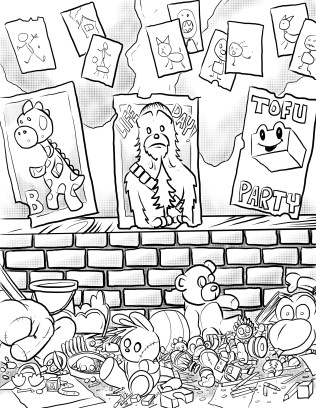
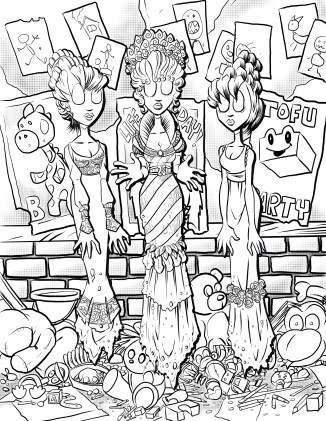
I have two completed pages, and I am applying lessons learned from the first book to these images. First off, I’m drawing the backgrounds separately, which is allowing me to experiment with the sizing of the characters on the finished page. This should cut down on characters getting clipped during the print process, since I am going for a full bleed on the layout.
Here’s the background for a daycare center:
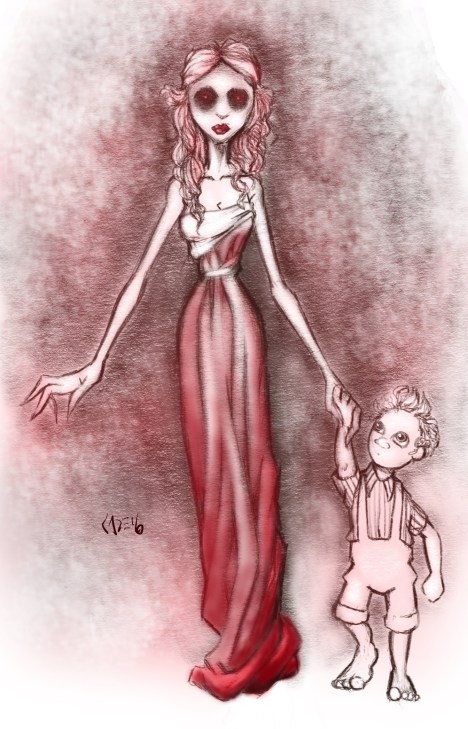
Now, with the Vampire Brides from last week:
Concept sketches are done for another 8 monsters, so I will be spending the next few weeks getting those ironed out, backgrounds rendered, then layouts. I aim for 23 coloring pages in each book, plus stories, so it’s a bit of a process!
Progress on Grimmleigh’s Morbid Stories for Dreadful Children is coming along nicely, with page 23 posting to Tapastic last night, and pencils for page 24 and 25 in the rough stage. I am hoping to get back to a weekly posting schedule with that story!
Going back through previous pages, I realized that I need to go back and re-work a number of pages. Some of the previous pages are formatted differently, and I need to get a unified font size in place. Luckily, that will just make everything flow better, so I am happy about that. I also realized that I forgot to even introduce the Miller, which is probably just a smidge confusing.
The real challenge for this next week is going to be Salt Lake Comic Con. I have a ton of panels, three live recording sessions of Geekshow, and a role playing game scenario to create. That being said, I’m setting a personal goal to keep daily posts going here!
Not in some theological “I really should have done that one thing instead of that other thing” sort of way. More like a “these are so freaking cool I am going to sell all my blood to buy them” sort of way. I’ll get back to that in a minute.
Look, I love monsters. Anyone who has checked out more than one post on this page knows that. Anyone who knows me personally really knows that. And by monster, I am an equal opportunity enthusiast of anything in the para-zoological sphere; give me your faeries, your kelpies, your poor huddled goblins.
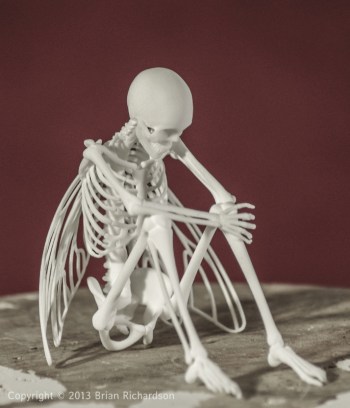
So, when someone does something monstrously cool, I kind of fall for that project. Yesterday, I stumbled upon Mythic Articulations. Check this out:
That’s the skeleton of a wetland fairy. I can’t get over how cool this is! Could you imagine having one of these sitting on your desk, or under a glass dome? I’m thinking about getting one and using some acrylic glazes to give the bones a patina.
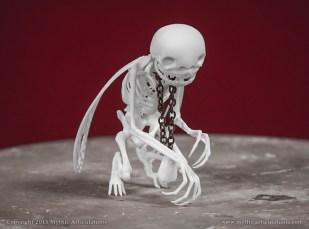
This little bundle of nightmare tonic is the Tooth Fairy skeleton, and seriously couldn’t be any cooler!
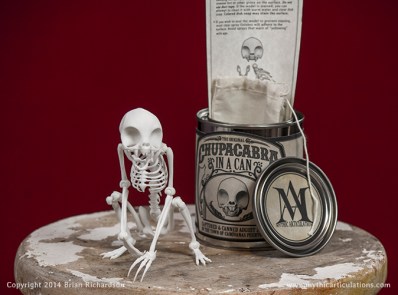
I was wandering around the site, checking out the cool skeleton art posters, skulls, and the other monster skeletons when I saw something that took the air right out of me. How freaking cool is this?
Yeah, that’s a Chupacabra skeleton in a can. It’s a model kit, kids. And because the folks at Mythic Articulations made the bones with ball-socket connectors, these kits are completely poseable.
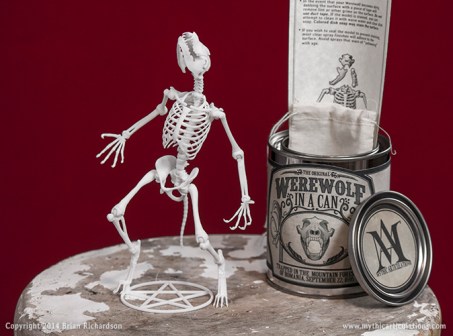
Here’s a werewolf for those of you into more traditional horror tropes. I prefer the fairy skeletons, personally; I really want to fill my studio with little skeletons under glass!
The price range might seem a bit steep on the surface; most of the skeletons are over $60, but there are art prints and books available for less than $30. Compared to a lot of collectibles they are actually pretty affordable, and your money is supporting a small business that creates unique and imaginative art.
Mythic Articulations uses state of the art 3-D printing technology, and makes each monster to order. You can check out all of their monsters here, or purchase them directly from their Etsy shop.
Russia is lousy with monsters. Seriously. You can’t swing a wet kobold without hitting some sort of gremlin or beastie. And the farther you get from the cities, the more bizarre and unusual the monsters get!
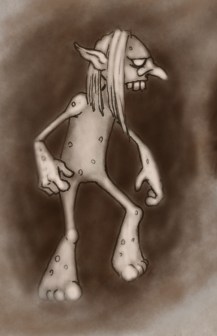
The Shishiga is an aquatic goblin that haunts the swamps and lakes of Russian and Slavic regions. I’m not positive that the Shishiga actually goes as far as Western Europe, but I think it’s safe to say that any area with Baba Yaga legends probably has Shishiga lurking about and mucking up the waterways.
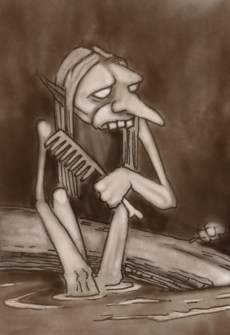
Shishiga are not fond of clothing, they are described as being naked little fiends, with clammy white skin and tousled hair. The common Shishiga is most often seen sitting on a log or shoreline, muttering to itself and combing its hair. Sadly, this is also an omen that the person seeing the Shishiga is going to drown soon, or die of mysterious causes. Whether this death is caused by the Shishiga, or it is just acting as a messenger of death is unknown.
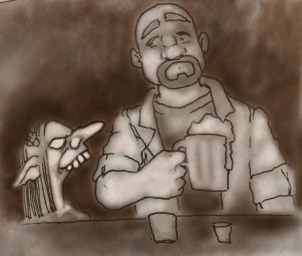
Shishiga are notorious for harassing people, (a common goblinoid trait) and like to steal things from unwary people’s homes. The all-time favorite pastime of the Shishiga, though, is bringing misfortune to drunkards. Shishiga have been known to enter taverns and steal money, cause accidental lewdness, and manipulate a victim’s clothing so that their pants or shirts would fall off when they attempt to stand up. Some might say that drunks and cowards manufactured the Shishiga to pass the blame for their poor behavior, but those well versed in goblin psychology know the truth.
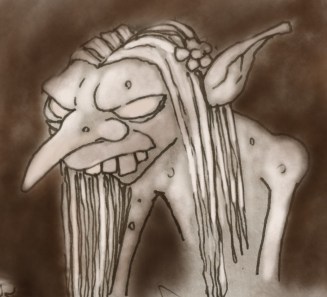
The Shishiga artwork in this post are concept sketches for the Shishiga page in my upcoming coloring story book, Grimmleigh’s Mythic Horrors. My current book, Grimmleigh’s Beastly Oddities, is available on Amazon now.
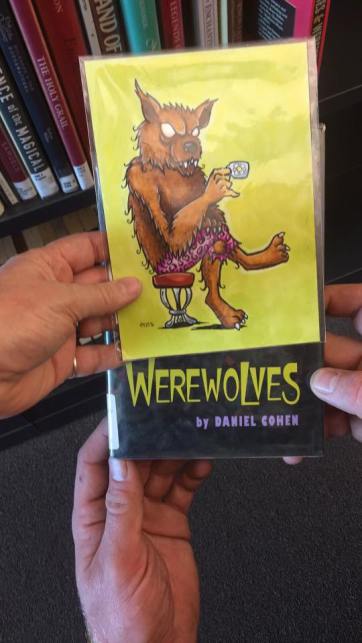
THAT WAS FUN! Our shy werewolf was found yesterday afternoon, she was hiding out in the Folklore section on the third floor of the Salt Lake City Library! Thanks for having fun with us yesterday!
We’re not going to ask how she manages three hands…




 Grimmleigh's Lab